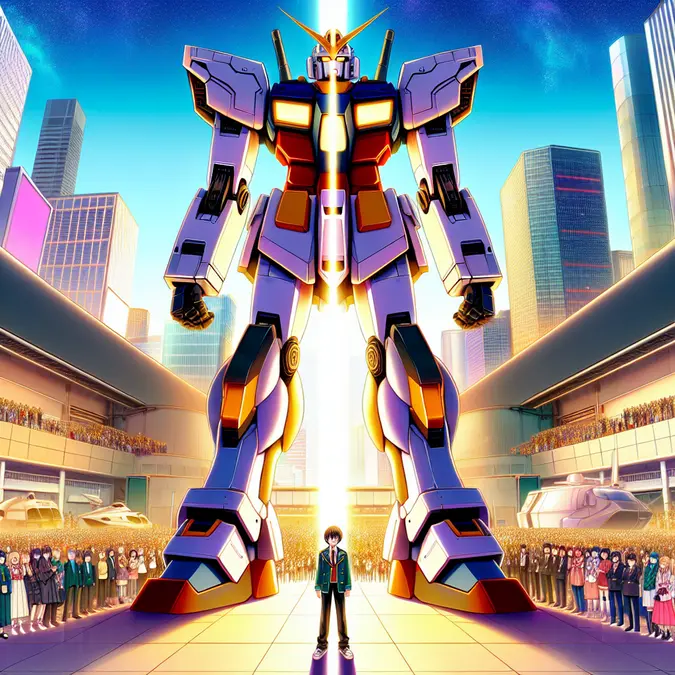
www.toponeraegunbuster.com – Gundam Divide has officially broken the internet! Comic Book Resources just dropped a spicy take blaming Gundam as the perfect line in the sand between Japanese viewers and overseas anime fans, and Nani?! The mecha discourse is in full nuclear alert mode!
The original CBR piece argues that the massive Mobile Suit Gundam franchise isn\u2019t just another long-running series\u2014it\u2019s the fault line that reveals how differently Japan and the international audience watch, love, and debate anime. From toy culture and war drama to streaming habits and nostalgia, the Gundam Divide is real, and it\u2019s more complicated than a 4D chess match between Char and Amuro.
Gundam Divide Explained: Why Japan & Global Fans Clash
At the core of the Gundam Divide is history. In Japan, Gundam is basically cultural infrastructure. Since 1979, it\u2019s been tied to real-world history, model-kit culture, and late-night reruns that raised generations. To many Japanese fans, it\u2019s serious war drama first, cool robot sakuga second.
Internationally though, a huge slice of viewers came in through flashier gateways: Toonami-era hits, modern streaming, or series like Gundam 00 and Iron-Blooded Orphans. For them, Gundam can feel dense, political, and \”homework-tier\” compared to instantly punchy shows like My Hero Academia or Demon Slayer. That clash of expectations is exactly what the article frames as Gundam being \”the real problem.\”
Real Robot Roots vs Spectacle-First Mecha
The CBR discussion points out that Gundam helped define the \”real robot\” subgenre: grounded tech, military hierarchies, and tragic consequences. But a lot of newer international fans met mecha through wild \”super robot\” energy: hot-blooded shouting, city-sized punches, and pure rule-of-cool like Tengen Toppa Gurren Lagann.
So when they circle back to classic Gundam, they don\u2019t always get the explosive power fantasy they expect. Instead, they run into politics, trauma, and episodes focused on supply lines and strategy briefings. For Japanese fans raised on this style, that\u2019s the good stuff. For newcomers, it can feel like a pacing brick wall.
7 Shocking Truths Behind the Gundam Divide
1. Gundam Is a Lifestyle Brand in Japan
CBR highlights how in Japan, Gundam isn\u2019t just anime, it\u2019s ecosystem. Gunpla model kits, museum exhibits, life-sized statues in Odaiba, department store collabs – it all locks Gundam into everyday life. That kind of omnipresence makes it easier to accept slow-burn storytelling, because the franchise stays constantly visible and culturally \”normal.\”
2. Overseas Fans Meet Gundam Out of Order
Unlike Japan, where TV reruns and consistent marketing guide viewers, international fans often jump in randomly: maybe Wing on TV, then 00 on streaming, then clips of The Witch from Mercury on social media. CBR suggests this fragmented entry path makes the franchise feel intimidating and inconsistent, fueling the idea that \”Gundam is confusing\” or \”only for hardcore veterans.\”
3. Political Drama vs Adrenaline Addiction
The article leans into the notion that global anime fandom today is trained by fast-paced bangers. Battle shonen, modern isekai, high-octane action all deliver dopamine in minutes. Gundam, especially its older entries, builds tension over cour after cour. That slow-burn character-driven war narrative is gold for Japanese Gundam lifers, but a tough sell when your watchlist is stacked with instant-hype series.
4. The Burden of Being \”The Mecha Representative\”
CBR also hints that Gundam unfairly carries the entire Western reputation of mecha on its shoulders. If someone tries one Gundam series and bounces off, they might write off the entire genre. That\u2019s wild when you remember how different something like Neon Genesis Evangelion or Code Geass feels from classic Universal Century Gundam, even though they share robot DNA.
5. Toy-Driven Origins vs Streaming-First Culture
The piece reminds readers that Gundam was born tightly linked to toy and model-kit sales in Japan. Story arcs and mobile suit designs were deeply tied to what would sell. Meanwhile, the modern global audience tends to encounter anime as \”pure media\” through streaming, not as part of a toy marketing machine. That disconnect makes some Gundam series feel strangely \”old industry\” to overseas eyes.
6. Translation, Terminology, and Tech Jargon
Another subtle divider the article points to is language. Mecha jargon, military ranks, and technical terms can get heavy in Gundam. If the localization choices feel stiff or confusing, foreign viewers might emotionally disconnect. Japanese fans, who naturally swim in that terminology, don’t hit the same barrier, strengthening the divide.
7. Nostalgia Armor Is Stronger in Japan
For many Japanese fans, even \”flawed\” series are protected by killer nostalgia armor: childhood broadcasts, playground debates over which mobile suit is Best Boy, family memories of building Gunpla together. International viewers who don\u2019t share that emotional history judge each show more harshly on modern pacing, animation, and accessibility.
Is Gundam Really the Problem, or Just the Perfect Mirror?
The firecracker conclusion of the CBR article is that Gundam might not be the villain; it\u2019s the clearest mirror of how differently Japan and the world consume anime. Where Japan sees a multi-generational war epic with deep cultural roots, a chunk of international fans see a dense, intimidating homework assignment hidden inside cool robot designs.
Instead of blaming Gundam, the debate really exposes how fandom has evolved: from toy aisles to Twitter threads, from VHS to simulcast. The Gundam Divide is less a curse and more a challenge: can the global audience meet the franchise halfway, and can the franchise continue offering gateway entries like The Witch from Mercury that balance accessibility with its trademark war drama?
One thing is certain: as long as mecha exists, the Gundam discourse will keep raging like a beam saber duel at sunset. And for otaku everywhere\u2014that ongoing clash of perspectives is half the fun.